Leave Your Message

How to Choose Weight Lifting Dumbbells for Your Business?

Choosing the right dumbbells for your business requires more than comparing prices and weight ranges. A gym owner, hotel manager, or fitness retailer must consider safety, durability, user comfort, and long-term value. The best Weight Lifting Dumbbell should match your customers, available floor space, training style, and expected daily use. A compact studio may prefer adjustable models, while a busy commercial gym may need fixed dumbbells with reinforced coatings.

Practical inspection matters. Hold each handle. Notice the balance. Check whether the grip feels secure when your palms become sweaty. Examine the heads, seams, coating, and weight markings under bright light. These details often reveal manufacturing quality better than attractive product photographs. In real purchasing work, buyers sometimes focus too heavily on the lowest unit cost. That choice can create higher replacement expenses later. It is not always the cheapest option.

Reliable suppliers should provide clear specifications, material information, quality-control records, packaging details, and consistent communication. Ask about weight tolerance, corrosion resistance, warranty coverage, and replacement procedures. Independent testing or recognized industry standards can strengthen confidence, but documentation still requires careful review. Do not accept impressive claims without evidence.

This guide explains how to compare suppliers, designs, materials, and total ownership costs. It also considers storage, maintenance, customer feedback, and future expansion. Some decisions will remain imperfect. Demand can change, and even a well-tested product may not suit every user. A careful trial order, followed by honest staff and customer feedback, can reduce that uncertainty before a larger investment.
How to Choose Weight Lifting Dumbbells for Your Business?

Segment Customers Using WHO’s 2+ Weekly Strength-Training Benchmark

How to Choose Weight Lifting Dumbbells for Your Business?

WHO recommends muscle-strengthening activities at least two days weekly. This benchmark creates a practical customer segment.

The WHO Global Status Report on Physical Activity 2022 estimates that 31% of adults worldwide are insufficiently active. In the United States, only 26.3% of adults met both aerobic and muscle-strengthening guidelines in 2020, according to the National Center for Health Statistics.

Your customers may need different dumbbell paths.

Customers training twice weekly often need simple, repeatable progression. Offer lighter pairs for beginners, medium weights for regular users, and heavier options for experienced lifters.

Adjustable dumbbells can save floor space, but fixed pairs usually allow faster transitions during busy sessions.

Check handle diameter, grip texture, weight accuracy, and rack stability.

I have seen businesses overbuy heavy equipment while neglecting accessible starting weights. That mistake can reduce use and increase unused inventory.

The two-day benchmark helps, but it cannot describe every customer.

Tips:

Review sales and booking data every quarter. Track which weights users actually select. Keep small increments available, especially between beginner and intermediate loads. Test storage with real traffic, not just an empty showroom. A neat rack is useful. A crowded walkway is not. WHO guidance supports segmentation, but local behavior should challenge your assumptions.
Match Dumbbell Loads to ACSM’s 8–12-Repetition Resistance Standard

How to Choose Weight Lifting Dumbbells for Your Business?

Match Dumbbell Loads to ACSM’s 8–12-Repetition Resistance Standard

For most beginner and intermediate users, the 8–12-repetition range offers a practical starting point for strength training. The load should feel challenging while allowing controlled movement and consistent technique. If a user completes 12 repetitions easily, the dumbbell may be too light. If form breaks before eight repetitions, it may be too heavy.

A business should stock gradual weight increases, not only a few large dumbbells. Small increments help users progress without sudden jumps. A useful commercial range might include light pairs for rehabilitation and warm-ups, medium pairs for general training, and heavier options for experienced lifters.

Storage space, floor protection, grip comfort, and cleaning routines also matter.

Fit matters.

ACSM guidance supports adjusting resistance as strength improves, but no chart replaces observation. A short movement assessment can reveal whether a customer needs less weight or a slower tempo. I once thought heavier equipment showed better value; that assumption was incomplete. Customers often need accessible steps between loads.

A simple usage log can record completed repetitions, technique concerns, and frequent weight requests. It will not be perfect. Real classes are unpredictable. Still, these records can guide future purchases more reliably than guesswork.

Compare Fixed, Adjustable, and Hex Dumbbells by ASTM F2276 Safety Criteria

How to Choose Weight Lifting Dumbbells for Your Business?

ASTM F2276 should guide your commercial dumbbell evaluation. Check the current edition and confirm that its scope covers your intended equipment and use. The standard addresses fitness equipment safety through design, construction, performance, and testing considerations. Do not rely on a supplier’s compliance statement alone. Request test records, material details, maintenance instructions, and clear warnings.

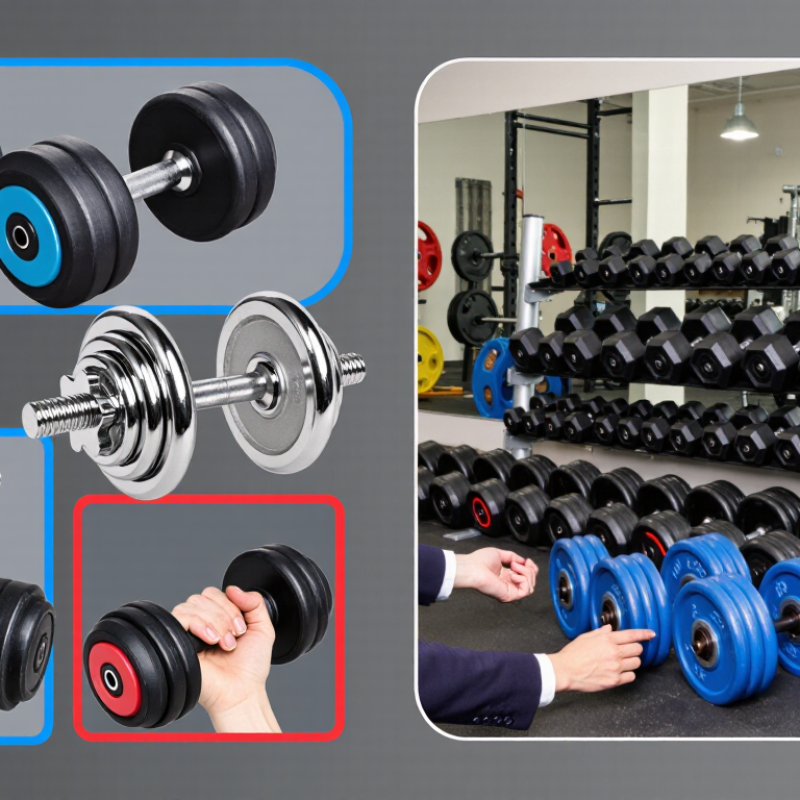
Fixed dumbbells usually provide the simplest user experience. Their handles and heads have fewer moving parts. Inspect the connection carefully. Test for looseness, sharp edges, surface cracks, and unstable placement. Hex-shaped ends can reduce rolling, especially on busy gym floors. However, a hex profile does not automatically prove compliance. Check dimensions, balance, grip clearance, and impact resistance under realistic use.

Adjustable dumbbells save storage space, but their locking systems deserve closer attention. Examine weight retention during repeated lifting, repositioning, and accidental contact. Look for pinch points around plates, collars, and selector mechanisms. Staff should be able to identify wear quickly. A small failure can interrupt a class and create an avoidable hazard. Fixed units may cost more in storage, while adjustable units may require more inspection time. That trade-off is easy to underestimate. No choice is perfect. Record your own trial results, including noise, grip comfort, floor stability, and cleaning access. A practical review often reveals problems that product sheets miss.

Build SKU Tiers with 1–2 kg Increments for Progressive Overload

When choosing dumbbells for a commercial range, design around progression, not isolated price points.

The World Health Organization recommends muscle-strengthening activities on at least two days weekly for adults. ACSM’s 2024 Worldwide Survey placed traditional strength training among the five leading fitness trends. That demand favors equipment supporting steady load increases.

Build a clear SKU ladder with 1 kg or 2 kg increases per dumbbell. A beginner may move from 4 to 5 to 6 kg. A stronger user may need 20, 22, and 24 kg.

Smaller jumps suit presses, raises, and rehabilitation-focused training. Two-kilogram steps simplify stocking for rows, squats, and deadlifts. Keep the ladder clear. Missing intermediate weights can encourage poor form or stalled progression.

For purchasing teams, map every tier to training goals, shelf space, and turnover. The Health & Fitness Association’s 2024 Global Report recorded more than 184 million fitness-facility members worldwide in 2023. Demand remains uneven across markets. Reserve deeper stock for mid-range weights, where general members often train.

Test heavier tiers before expanding them. Use durable knurling, flat storage, and readable weight markings. These details affect handling and staff checks. A 2 kg ladder is not always right. Some customers progress slowly, skip sizes, or prefer adjustable options. Review sales, breakage, and rental data quarterly before changing the next purchase.

Verify Materials, Handles, Labels, and Testing Under EN 957-1 Requirements

EuropeActive and Deloitte’s 2024 European Health & Fitness Market Report recorded 71.6 million club members across Europe. That scale raises equipment expectations. For business purchases, inspect the dumbbell’s material certificate, not only its finish. Steel, cast iron, and rubber coatings should match the supplier’s declared specification. Check for cracks, sharp edges, loose heads, and coating gaps. A bright sample can still hide weak bonding.

The handle needs equal attention. Measure its diameter, length, grip texture, and rotation under load. Knurling should support control without cutting the palm. Ask for corrosion checks and repeated-load results. Under EN 957-1 requirements, request a test report covering stability, construction, accessible hazards, warning information, and foreseeable misuse. The report should identify the exact model, test date, laboratory, and production batch. If the supplier cites EN 957-1 loosely, pause. The standard’s applicability should be confirmed against the current procurement specification.

Labels must remain readable after cleaning and heavy handling. Include weight, manufacturer traceability, safety warnings, and inspection guidance. Match every carton, sample, and certificate. Small discrepancies matter. A 10 kg marking with inconsistent measured weight can damage user trust and complicate inventory control. I would also keep a retained sample from each shipment. It feels excessive, but memory is unreliable, and a perfect pre-shipment report cannot prove every later batch is identical.

How to Choose Weight Lifting Dumbbells for Your Business?

Verify Materials, Handles, Labels, and Testing Under EN 957-1 Requirements

The chart shows a practical procurement review priority score from 1 to 5. Higher scores indicate areas that should receive more attention when evaluating dumbbells for commercial use. Request material specifications, secure-handle evidence, permanent safety markings, and documented strength or durability testing. EN 957-1 provides general safety requirements and test methods for stationary training equipment; confirm the applicable edition and product scope with a qualified testing laboratory before claiming compliance.