- Home
- Products
- About Us
- News
- Contact Us
Leave Your Message
Buying Metal Dumbbells in bulk looks simple until the first shipment arrives.
A commercial order must survive repeated drops, chalk, sweat, transport, and rushed storage. The American College of Sports Medicine’s Worldwide Survey of Fitness Trends has repeatedly ranked traditional strength training among leading fitness priorities. That trend supports continued demand for dependable free weights in gyms, hotels, schools, rehabilitation centers, and home-training facilities. Meanwhile, the Health & Fitness Association’s 2024 consumer research reported strong participation across U.S. fitness facilities, showing why commercial buyers need equipment that performs beyond a short promotional cycle.
Price is only one part of the decision.
This guide explains ten practical checks for selecting Metal Dumbbells in bulk, including weight accuracy, handle geometry, knurling, coating durability, packaging, and supplier consistency. A small defect becomes expensive when multiplied across 200 or 1,000 units. Uneven heads can damage racks. Poorly finished handles can create uncomfortable pressure points during high-repetition training. These details are easy to miss in a catalog image.
Real procurement is less tidy.
A supplier may provide a low quote, yet freight, replacement units, customs handling, and inconsistent production can change the final cost. Industry quality principles, including documented inspection and traceable specifications, should therefore guide every order. Buyers should request samples, clarify tolerances, verify test records, and compare the delivered product with the approved sample. No report can replace physical inspection. That is an inconvenient truth, but ignoring it can turn a “bulk discount” into long-term waste.
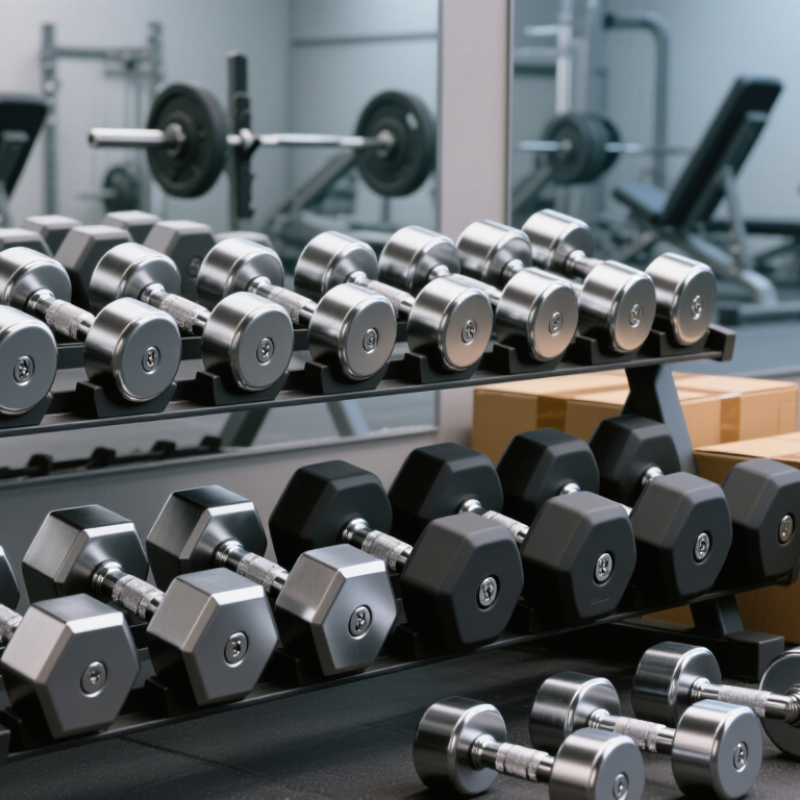
Before buying metal dumbbells in bulk, define how they will be used. A home gym needs a different range than a busy training facility. List the main exercises, user abilities, and weekly training volume. Include presses, rows, curls, lunges, and lighter rehabilitation movements. Each exercise may require a different load.
Record the starting weight and planned progression for every user group. Beginners may need pairs from 2.5 to 15 kilograms, while stronger users may require heavier options. Do not buy only the popular middle range. Light weights often support shoulder work and warm-ups. Heavy pairs support compound exercises. Leave sensible gaps between sizes, or progression may feel awkward.
I once ordered too many heavy dumbbells and too few light pairs. That mistake reduced training variety and wasted storage space. Measure the rack, floor area, and delivery route before placing a large order. Check handle diameter, grip texture, weight tolerance, and surface protection. These details affect comfort, safety, and long-term maintenance. Ask for sample units when possible. Test them after repeated use, not just during a brief inspection. A small quality difference becomes obvious when dozens of people train daily. Keep a written inventory, including weight, pair count, condition, and replacement needs. Your estimate may be imperfect. Review it after several weeks.
| Tip | Training Need to Assess | Practical Weight Range | How to Determine the Range | Bulk-Buying Consideration | Recommended Check |
|---|---|---|---|---|---|
| 1 | Define the main users | General fitness users often need approximately 2–20 kg per dumbbell (4–44 lb). | Separate users by training experience, age, physical ability, and exercise goals rather than using one range for everyone. | Create user groups before calculating quantities so lighter and heavier weights are not purchased in equal numbers by default. | Prepare a short user profile and expected percentage of each group. |
| 2 | Match weights to exercise type | Upper-body movements commonly use lighter loads than lower-body movements. | Plan for exercises such as lateral raises, curls, presses, rows, lunges, and goblet squats separately. | A useful bulk assortment normally includes more light and medium pairs than very heavy pairs for mixed-use facilities. | List the top 10 exercises and record the expected working weight for each. |
| 3 | Set a beginner-friendly starting point | A starting selection of about 2–10 kg per dumbbell (4–22 lb) covers many introductory movements. | Choose weights that allow controlled technique and the target repetitions without excessive strain. | Include sufficient lighter pairs because new users often need gradual progression and technique practice. | Confirm that users can increase load in small, manageable steps. |
| 4 | Plan progressive overload | Use regular increments such as 1–2 kg per dumbbell for lighter loads and 2–5 kg for heavier loads when appropriate. | Progression should preserve form, range of motion, and the planned repetition target. | Avoid large gaps between adjacent weights; uneven increments can limit programming options. | Review the proposed weight ladder and identify gaps greater than the facility can reasonably manage. |
| 5 | Choose the measurement system | Common metric sizes include 2, 4, 6, 8, 10, 12, 14, 16, 18, and 20 kg. | Common imperial equivalents include approximately 4, 9, 13, 18, 22, 26, 31, 35, 40, and 44 lb. | Using one primary measurement system reduces labeling confusion and simplifies storage management. | Confirm that labels, training plans, inventory records, and user instructions use the same units. |
| 6 | Calculate the number of pairs | Most bilateral dumbbell exercises require one matching pair; unilateral work may use one dumbbell. | Estimate peak simultaneous users and multiply the number of required stations by the number of concurrent users. | Plan in pairs for standard workouts, then add a small single-dumbbell reserve only if unilateral training is common. | Use: Required pairs = peak users × planned stations × utilization factor. |
| 7 | Consider strength differences by movement | A user may need 4–8 kg for a shoulder exercise but substantially more for a squat or row. | Do not estimate the full range from one lift; compare at least one upper-body and one lower-body movement. | Allocate inventory by movement demand instead of assuming every weight will have the same turnover. | Use workout logs, class plans, or trial sessions to identify the most frequently requested sizes. |
| 8 | Allow for strength progression | For a general training area, extending the range toward 24–30 kg per dumbbell (53–66 lb) may support stronger users. | Add heavier sizes only when current users, planned programs, and available space justify them. | Heavier metal dumbbells require stronger storage, safer handling procedures, and additional floor clearance. | Check actual demand before extending beyond the core range. |
| 9 | Verify space and storage capacity | A full set from 2–20 kg in 2 kg increments contains 10 pairs, or 20 individual dumbbells. | Measure rack length, shelf depth, walking clearance, and the load capacity of the storage structure. | The number of dumbbells, not only their total weight, determines how much storage space is required. | Approve a layout drawing before placing a bulk order. |
| 10 | Build a reorder and replacement plan | Keep the most-used sizes available and review inventory after 30–90 days of regular use. | Track usage frequency, damaged handles, missing pairs, surface wear, and changes in training programs. | A replacement budget and standardized weight list help maintain complete, matching pairs. | Set minimum stock levels for high-use weights and document inspection intervals. |